

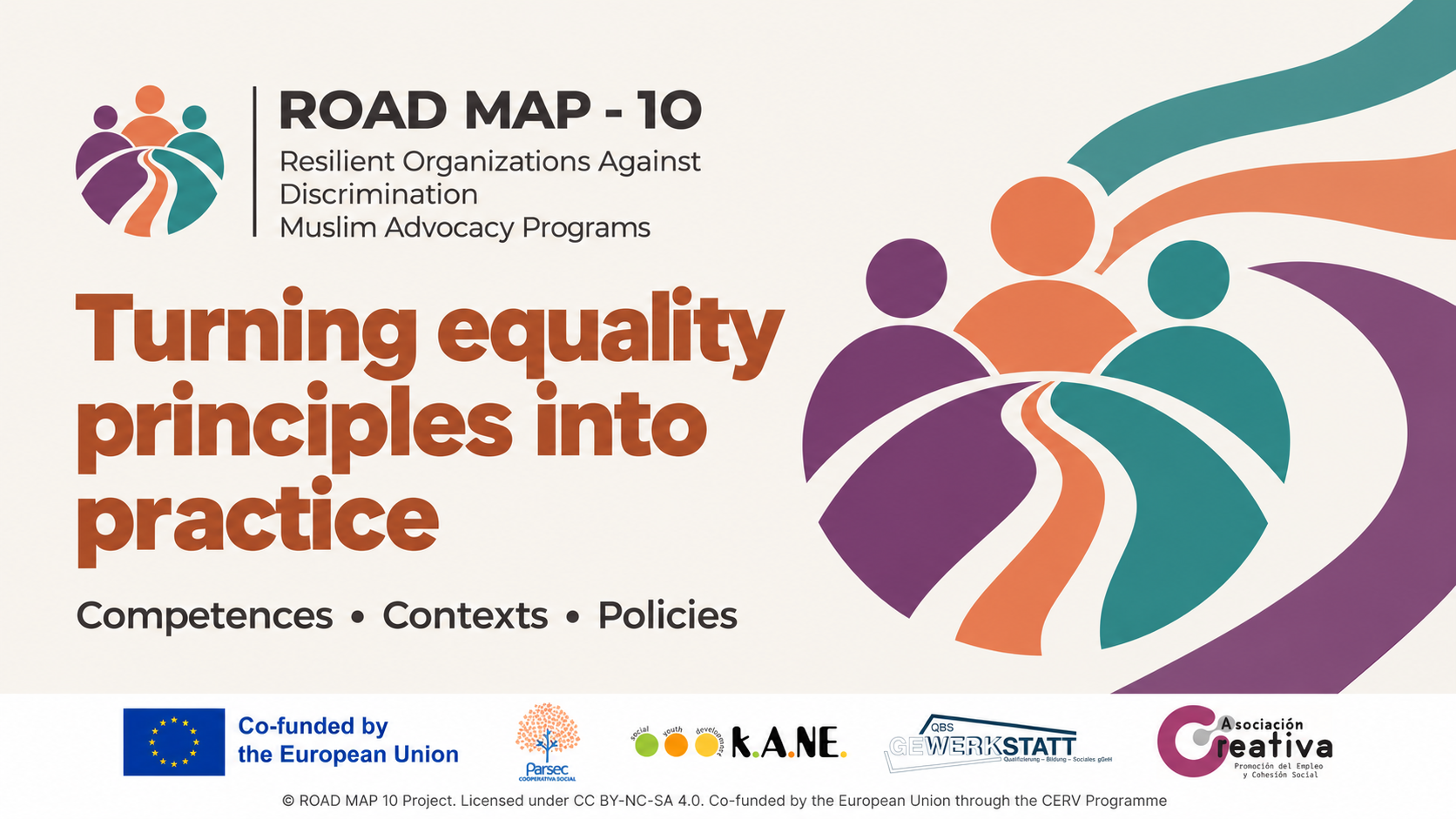
ROAD MAP 10 is a European project aimed at preventing and countering anti-Muslim discrimination by strengthening cooperation between young people, youth and social workers, cultural mediators, schools and employment services.
The project responds to the gap between existing equality legislation and its practical implementation. It follows an integrated approach based on three interconnected dimensions — Competences, Contexts and Policies — combining professional capacity building, peer education, cultural mediation and policy advocacy.
ROAD MAP 10 will train youth and social workers and cultural mediators, while empowering young Muslims to become peer educators and active agents of inclusion. Across the four partner countries, 40 young Muslims will be trained as peer educators and cultural mediators, and 24 educational sessions will be implemented in secondary schools and employment centres, reaching at least 240 young people. The project will also develop three 10-point Decalogues on Competences, Contexts and Policies, providing practical recommendations for professionals, institutions and policymakers.
K.A.N.E. – Social Youth Development leads WP3: Peer Education and Cultural Mediation. K.A.N.E. coordinates the selection and training of peer educators and cultural mediators and supports the implementation of educational sessions in schools and employment services. It also contributes to the development of the Decalogue of Contexts, documenting effective approaches for inclusive interaction.
Partners:
- Parsec Cooperativa Sociale – Italy (Coordinator)
- Gewerkstatt gGmbH – Germany
- A.N.E. – Social Youth Development – Greece
- Asociación Creativa – Spain
Programme: Citizens, Equality, Rights and Values (CERV)
Duration: 20 months. July 2026 – February 2028
Website: www.roadmap10.eu

Disclaimer: Co-funded by the European Union through the CERV Programme. Views and opinions expressed are however those of the author(s) only and do not necessarily reflect those of the European Union or the European Education and Culture Executive Agency (EACEA). Neither the European Union nor EACEA can be held responsible for them.